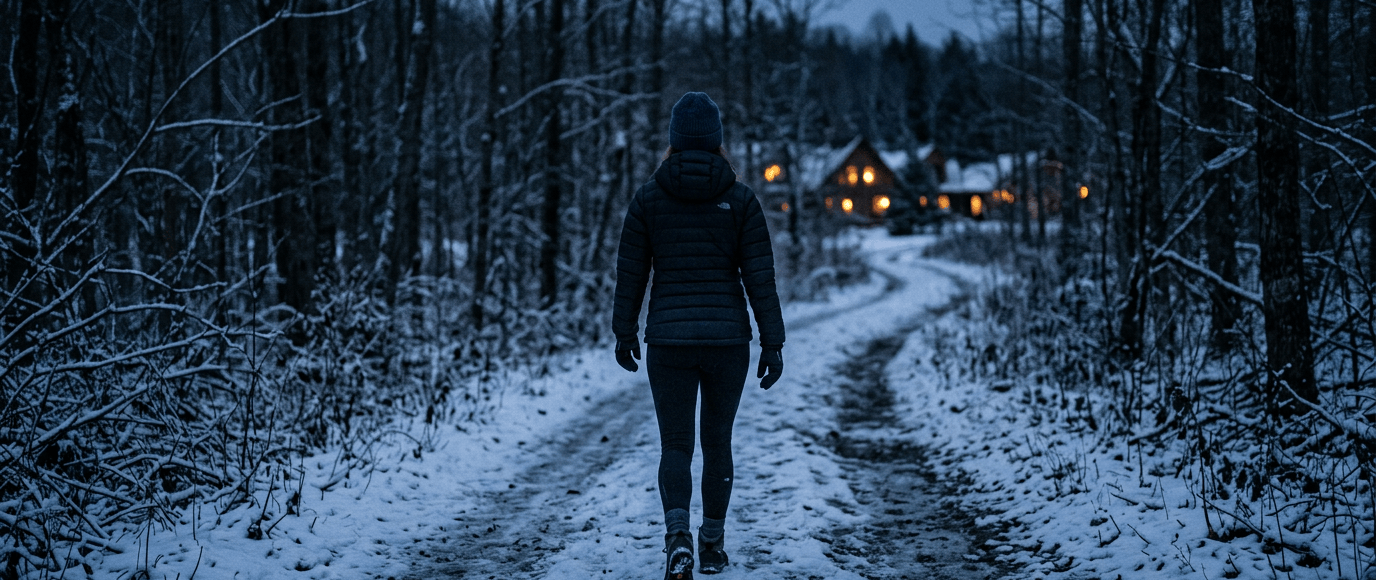

By half four it’s dark. The walk to the gym is wet, the sofa is warm, and the session you meant to do becomes the session you’ll definitely do tomorrow. If that sounds familiar, you’re in good company. November is where a lot of training years quietly end.
Here’s the thing, though. It’s not you. Well, it’s not only you.
It’s not a character flaw
A systematic review by physiotherapy researchers at the University of Valencia pulled together 26 studies covering about 9,300 adults in 18 countries, all measuring how much people move across the year. Twenty-two of the 26 found the same pattern: activity peaks in summer, bottoms out in winter, and sitting time climbs the opposite way. Different countries, different ages, different ways of measuring, the same direction.
One detail is worth being precise about. A few of the 26 studies, mostly small ones and several in cold-climate countries, found no statistically significant seasonal difference. That isn’t proof those places have no winter dip: not finding a significant difference isn’t the same as proving there isn’t one, and no country gets a certified exemption. The honest summary is simply that most studies found the dip and a few didn’t find it.
What carries people through
The pattern appears across many studies, though it isn’t the same for everyone. So if your November looks like this, it isn’t a personal failing.
The closest thing found to an experiment on this: researchers at the University of Wisconsin Madison Team assigned healthy adults to an eight-week structured exercise programme, a mindfulness course, or nothing at all, starting in late summer. By November, the nothing group had lost about 18 minutes of activity a day. Everyone dipped a bit on that measure. But look at the longer sessions, bouts of ten minutes or more, the measure this trial used for training sessions. The structured-exercise group held theirs, roughly level across the autumn. The nothing group lost over an hour of them a week. (The mindfulness group landed in between, with no statistically significant difference, so there’s no claim to make there.)
One small trial, one autumn, not proof of much. And to be straight with you: the trial measured movement, not motives. Nobody tracked motivation, routine or accountability, so it can’t tell us why the exercise group held its sessions, only that the group enrolled in something held them while the group left to its own devices lost them. Not proof that structure beats motivation. It’s one autumn’s evidence that being enrolled in something went with keeping the sessions going.
Regular readers will recognise the tune. We’ve talked here before about discipline workouts, the sessions that happen without the feeling behind them. Winter is almost a whole season of those. You don’t rise to the occasion in November; you fall back on whatever you’ve set up in October.
The winter plan, everyman edition
So much for the research. From here it’s suggestion, not science: plan the winter now, while it’s still a choice. Not a heroic plan. A small one that survives a dark Tuesday.
Fixed slots. The session goes in the week like a meeting, same days, same times. Deciding fresh every day is where winter wins.
An indoor default. If the fallback is the gym or the front room rather than the weather’s permission, rain stops getting a vote.
Shorter sessions that still happen. Twenty minutes that happened beats sixty that were planned. January remembers consistency, not intentions.
And somewhere to be. In that trial the exercisers trained in weekly group classes, so someone was expecting them, whether that’s why they kept going, the trial can’t say. A class, a mate, a programme: it barely matters which. Accountability is accountability.
The honest part
The journey matters more than the result, and winter is where the journey gets honest. Summer fitness is easy to enjoy. The dark months are where the habit itself becomes the thing you’re training. You don’t need more motivation this winter. You need fewer decisions. Make them once, now, and let the routine carry the months the weather can’t.


0 comments on “Training through the dark months”